Table of Content
Table of Contents
Companies use air freight transport when they need to deliver their goods quickly internationally. This is generally much faster than sea freight, which is the reason it is preferred for urgent orders, important items, and time-sensitive deliveries. Air freight services, however, tend to be pricey, and decision-making takes thorough consideration.
Before booking a delivery, firms need to check the weight and volume of the shipment, its packing type, the required papers, and the recipient’s needs. Knowing how air freight works, as well as the export and import procedures and charges, as well as what mistakes are common while booking, is needed to avoid delays and unforeseen expenses.
Key Takeaways
- Air freight is perfect for urgent international shipments
- There are various air freight services that satisfy a variety of cargo transport needs
- Charges depend on the chargeable weight, the route, the type of handling, and other charges that may occur
- The firm must have all of the packing and documents ready before booking
What Is Air Freight and When Does It Make Sense?
Air freight is the use of airplanes for transportation of goods between countries using commercial planes or dedicated cargo aircraft. A freight forwarder organizes the shipping process, covering the booking of space, documentation, and customs clearance.
Companies often opt for air freight for electronics, pharmaceuticals, spare parts, samples, and other goods that need faster delivery. Air freight can help companies react to urgent customer requests or decrease the shipping duration.
At the same time, air freight may not be the cheapest option. Transporting heavy, oversized, or non-urgent cargo may be better suited for shipping by sea.
Types of Air Freight Services
The various types of air freight services are shaped by how large shipments are, time deadlines, and how many aircraft are available to carry goods. Knowing different ways of transporting shipments helps companies choose an appropriate service.
Consolidated air freight
Consolidated air freight combines shipments from several customers. The freight forwarder books bulk space with the airline under one Master Air Waybill (MAWB) and issues a House Air Waybill (HAWB) to each customer. Available cargo space is shared between the shipments, making this option suitable for customers with smaller consignments. It may reduce costs, although transit time can be affected by the consolidation schedule.
Direct Booking vs. Consolidation
Direct booking secures cargo space on a specific flight without waiting for consolidation. The routing depends on the flights available, rather than on the booking method. Depending on the schedule and available capacity, this may provide a suitable option for time-sensitive shipments.
Express and Courier Services
Express services relate most often to smaller packages and fast deliveries. It is a service usually provided by courier companies that take care of the pick-up process, transportation, customs issues, and delivery in the end. This method is commonly used for documents, samples, and lightweight shipments.
Air Charter Solutions
Air charter solutions refer to the launching of either an entire aircraft or a dedicated capacity of airplane in order to transport a particular cargo. These services are normally taken into consideration in case of carrying large, urgent, and special shipments that are not possible to deliver by regular airline services.
Air Freight Exporting from India
Exporting goods by air involves several stages, from requesting a quotation to dispatching the cargo. The process generally follows these steps.
Step 1: Provide Shipment Information and Obtain Quotation
The shipper submits information on the place of origin, destination, details about the cargo, number of items to be shipped, weight of items, volume of items to be shipped, and the estimated time of shipment. Apart from the required information, it is also important to indicate any specific requirements like temperature control or handling of hazardous goods.
Step 2: Book Cargo Space and Prepare Goods for Shipment
After accepting the quotation, cargo space is reserved on the carrier’s plane. The shipper prepares the required documents for the shipment, including a commercial invoice, packing list, air waybill, etc. The goods have to be properly packed for air transportation with the required labels and information about the shipment.
Step 3: Complete Export Customs Clearance
The shipper or authorised Customs Broker submits the Shipping Bill and the necessary documents to Indian Customs. Customs may inspect the cargo or request further information. Once the requirements are met and the Let Export Order (LEO) is issued, the shipment is cleared for export.
Step 4: Deliver Goods to the Terminal and Complete Airline Checks
After export customs clearance, the shipment is delivered to the airport terminal before the airline’s cut-off time. The cargo is checked for weight, dimensions, and security requirements. Once the airline accepts the cargo, the Air Waybill is finalised and the goods are handed over for loading.
Step 5: Departure Flight and Shipment Updates
Once the shipment is cleared and accepted, it is loaded on the scheduled flight. The freight forwarder works with the airline and destination agent to provide the latest information and facilitate the next segment of transportation.
Air Freight Importing into India
Managing import shipments requires coordination among an overseas supplier, freight forwarding agency, customs broker, importer, airline, and destination handling agent.
Stage 1: Receipt of Pre-Alert and Shipping Documents
The importer receives a shipment notification and associated documents, which include the invoice, packing list, and air waybill. Assessing these documents before shipment arrives helps determine any missing information.
Stage 2: Shipment Arrival at Indian Airport
The airline or the forwarding agent notifies the receiving team about the shipment’s arrival. The shipment is then moved to the designated terminal for customs clearance.
Stage 3: Submission of Bill of Entry and Payment of Relevant Duties
The importer submits the Bill of Entry through the customs broker or directly. The relevant duties and taxes are then calculated and paid accordingly.
Stage 4: Customs Inspection and Out of Charge Statement
Customs either inspects the imported cargo or seeks further documentation at any point. Once the necessary checks and formalities are completed, the customs authority issues the Out of Charge certificate, thereby releasing the goods from customs.
Stage 5: Get the Delivery Order
The importer or his representative obtains the Delivery Order from the airline or its appointed agent after fulfilling the necessary payments and formalities. This release document is needed before one collects the cargo.
Stage 6: Make Arrangements for the Final Delivery
Once the Delivery Order and terminal release formalities are completed, the cargo can be picked up or sent to the importer. However, delays may incur extra charges on storage and handling.
How Air Freight Costs Are Calculated
Shipping companies typically use the chargeable weight in determining rates for air freight. The chargeable weight is calculated based on the actual weight and the volumetric weight, and the larger of the two weights is applied to shipping costs.
The volumetric weight is computed using the following formula:
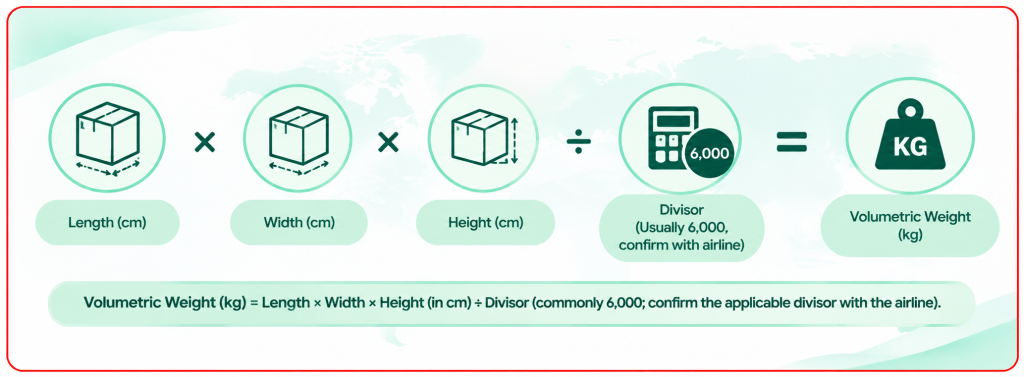
For example, if the dimensions of the package are 120 × 80 × 60 cm, its volume will be equal to 576,000 cubic centimetres. When applying the divisor of 6,000, it leads to the volumetric weight being equal to 96 kg, although it has an actual weight of 80 kg. Therefore, the chargeable weight will be equal to 96 kg. The necessary number of the divisor used must be confirmed depending on the type of service.
Moreover, there are other expenses that may be involved in the process of delivery
- Pick-up and origin service expenses
- Airline freight charges and surcharges for fuel
- Security and screening charges
- Customs clearance expenses
- Expenses related to delivery
- Storage expenses
Request an itemised quotation and check whether the price covers airport-to-airport or door-to-door transportation. Customs duties and taxes are separate from freight charges. The agreed Incoterms determine how responsibilities for transportation costs and other charges are divided between the buyer and seller.
Documents Required for Air Freight
Documentation depends on the cargo, destination, and applicable regulations. The following table covers commonly required documents.
| Document | Purpose | Usually Prepared By |
| Master Air Waybill (MAWB) | Contract and receipt for airline transportation | Airline or authorised agent |
| House Air Waybill (HAWB) | Shipment record issued to the customer | Freight forwarder |
| Commercial Invoice | Declares goods, value, and sale details | Exporter |
| Packing List | Provides package, weight, and dimension details | Exporter |
| Shipping Bill | Export customs declaration | Exporter or Customs Broker |
| Bill of Entry | Import customs declaration | Importer or Customs Broker |
| Shipper’s Letter of Instruction (SLI) | Provides shipment and handling instructions | Exporter |
| GST/LUT documents | Supports applicable export tax procedures | Exporter |
| Shipper’s Declaration for Dangerous Goods | Declares regulated dangerous goods | Trained and authorised shipper |
| UN 38.3 Test Summary and Safety Data Sheet | Supports applicable battery or chemical shipment requirements | Manufacturer, supplier, or shipper |
Additional permits or certificates may be required depending on the product and destination.
Common Air Freight Mistakes and How to Avoid Them
Incorrect shipment details, unsuitable packaging, and missing documents can lead to additional costs, delays, or cargo rejection.
| Mistake | What Happens | How to Avoid It |
| Incorrect cargo dimensions | Chargeable weight may be recalculated, increasing costs. | Measure every package accurately. |
| Improper packaging | Goods may be damaged during handling or loading. | Use packaging suitable for air transportation. |
| Missing or incorrect documents | Cargo acceptance or customs clearance may be delayed. | Verify documents before submission. |
| Undeclared dangerous goods | Cargo may be held or rejected for safety reasons. | Declare applicable dangerous goods and provide required documents. |
| Missing cargo cut-off time | Cargo may miss its scheduled flight. | Confirm terminal cut-off times and arrange delivery in advance. |
How to Choose an Air Freight Forwarder
An experienced air freight forwarder in India can help coordinate airline bookings, documentation, cargo handling, and customs procedures. Before selecting one, check:
- IATA accreditation or recognised air cargo agent status: Verify the relevant accreditation and its scope. Also check whether the forwarder is a BCAS-approved Regulated Agent where required for the shipment.
- Airline relationships and routing: Ask about available airlines, connections, and alternative routes.
- Cargo handling experience: Confirm experience with your goods, particularly specialised or dangerous cargo.
- Customs support: Check how export and import clearance will be coordinated.
- Pricing and tracking: Request an itemised quotation and clarify how shipment updates are provided.
Final Thoughts
Air freight can be a suitable choice when international cargo needs to move quickly. Checking shipment dimensions, packaging, documentation, costs, and destination requirements before booking helps reduce avoidable delays.
Right Logistics coordinates air freight arrangements for businesses with different cargo requirements. Discuss your air shipment with our team to identify a suitable shipping option.
Frequently Asked Questions (FAQs)
Is Air Freight More Expensive Than Sea Freight?
Yes. Air freight generally costs more per kilogram than sea freight. However, it may be suitable when quicker delivery, urgent customer requirements, or reduced inventory holding time is more important than the transportation cost.
What Is the Difference Between Air Freight and Air Courier?
Air freight is commonly used for commercial cargo and larger shipments, with transportation arranged through airlines and freight forwarders. Air courier services generally handle smaller parcels and include pickup and final delivery within their service.
Can I Ship Batteries or Chemicals by Air from India?
Yes, certain batteries and chemicals can be transported by air if they meet applicable airline and dangerous goods regulations. Classification, packaging, labelling, and documentation must be checked before booking. Requirements vary according to the product and its characteristics.
How Long Does Air Freight from India Take?
Transit time depends on the origin, destination, flight availability, cargo type, and customs clearance. Direct and connecting services may have different schedules. Confirm the expected transit time and allow for export and import processing before committing to a delivery date.